
Despite multiple headwinds at the start of 2023, the Indian markets delivered a strong performance, posting 19-20 per cent growth for the year. Even as new records were set, investor sentiment remains strong going into 2024, given the lower inflation, expectations of steady to lower interest rates, higher economic growth, and strong inflows. However, the overriding concern for most brokerages is valuations.

Get your lowdown on what's happening in the Kannada film industry.
We feel that P/E multiple is an important metric in evaluating the performance of a company from this sector.

Passenger vehicle dispatches from factories to dealers declined 13 per cent to the lowest level in five years in December last year as the industry continued to face production issues due to semiconductor shortage, auto industry body SIAM said on Friday. Passenger vehicle dispatches last month stood at 2,19,421 units compared to 2,52,998 units in December 2020. While acknowledging that the chip shortage situation is not expected to dramatically change in the short term, the industry body expressed hope that things will improve soon.

M&M was the top gainer in the Sensex pack, rallying nearly 6 per cent, followed by Bajaj Auto, Titan, Bajaj Finance, HDFC Bank and PowerGrid.

Ola Electric's initial public offering (IPO), of Rs 5,500 crore, is essentially aimed at ensuring the company maintain its top position in the electric two-wheeler segment, with incumbent players TVS and Bajaj Auto giving a fight to the number one player in market share. Most experts and competitors say the amount being raised is in line with the investment required to expand the electric-vehicle (EV) business. There are two discernible trends in the competitive electric two-wheeler market.
The final Budget for the fiscal is likely to be tabled in July after formation of the new government.

As Ayodhya readies itself for the glittering, much-awaited consecration ceremony of the Ram Mandir on January 22, and as millions of pilgrims and devotees pour into the holy city for the momentous event, companies are rushing to do their bit and be a part of the mega celebrations. Some are offering a part of their profits as donations, telcos are beefing up the number of cellular towers to ensure better connectivity, and there are those distributing jalebis and food platters.

The global billionaires list witnessed as many as 94 new entrants from India, stated a report by Hurun India on Tuesday. Following a net addition of 84, the country's billionaire tally touched 271 with their combined wealth at $1 trillion, noted the report. Mukesh Ambani, chairman & managing director of Reliance Industries, is the only Indian to make it into the top 10 of the Hurun Global Rich List 2024, a ranking of billionaires in US dollar terms.

The slowdown in private consumption in the economy is taking a toll on the growth of fast-moving consumer goods (FMCG). The net sales growth of listed FMCG companies hit a 14-quarter low of 2.5 per cent in October-December 2023 (Q3FY24). This is the lowest revenue growth for the industry since the June 2020 quarter, when the FMCG firms in the Business Standard sample had reported a 13.2 per cent Y-o-Y decline in combined net sales owing to the lockdown.

Amidst healthy demand, there are apprehensions of possible hike in excise duty, and hence the player seeks excise duties to be retained at current levels

The auto component sector grew at 5-6 per cent last year against a 13 per cent growth in 2012.
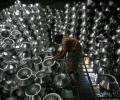
Hindalco's first quarter (Q1FY23) results indicate healthy domestic volumes for aluminium and copper, and lower cost of production. Subsidiary Novelis saw weak volume trends but it managed to push operating profit margins on a better mix and pricing hikes. The weak global outlook on aluminium is a cause for ongoing concern.

While commercial vehicle (CV) sales were the worst hit, down by 21 per cent to 67,793 units from 85,833 units, two-wheeler sales dropped by 16 per cent to 12,64,169 units from 15,00,545 units. Passenger car sales dropped nine per cent to 215,716 units from 236,586 units.

Maruti's sales of the compact segment comprising Swift, Estilo, Ritz, Dzire and Baleno went up by 9.9% to 45,579 units
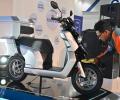
India's electric two-wheeler (E2W) sector is expected to cross the one million mark in 2024 fuelled by rising demand, increased production, and affordability, industry experts said, even as several original equipment makers are expanding their penetration to rural areas. Improved battery technology and innovative features are also likely to fuel growth, they said. "E2W sales will breach the 1-million mark in 2024 as the demand for electric two-wheelers is expected to continue growing due to factors such as environmental awareness, government incentives, and improvements in technology," Hyder Khan, chief executive officer (CEO), Godawari Electric Motors, said.

Investors' wealth zoomed by Rs 5,78,634.72 crore in two days of intense market rally, with participants adding Rs 2,74,908.83 crore to their fortune on Tuesday. Over the past two sessions, the BSE gauge Sensex has gained about 1,461 points or 2.99 per cent. The benchmark rallied 612.60 points or 1.24 per cent to settle above the 50,000-mark on Tuesday. Following the two-day massive rallies, the market capitalisation of BSE-listed companies jumped by Rs 5,78,634.72 crore to a record Rs 2,16,39,367.91 crore on Tuesday.

The Sway, which is the likely name for the Zica sedan has been codenamed as Kite 5.

The new Duster will go head-to-head with popular models like Hyundai Creta, Kia Seltos, Volkswagen Taigun, Skoda Kushaq, Maruti Suzuki Grand Vitara, Toyota Urban Cruiser Hyryder, MG Astor, etc in the highly competitive mid-size SUV segment.

Investors' wealth soared by Rs 10.58 lakh crore in three days of the market rally, where the BSE benchmark jumped over 2 per cent, and hit an all-time high on Monday. Extending its winning momentum to the third day running, the 30-share BSE Sensex jumped 363.20 points or 0.49 per cent to settle at 74,014.55. During the day, it zoomed 603.27 points or 0.81 per cent to hit its record high of 74,254.62.
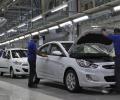
Leading automakers Maruti Suzuki, Hyundai and Tata Motors on Friday reported robust sales for February as demand for sports utility vehicles continued to remain strong. Mahindra & Mahindra, Toyota Kirloskar Motor and Honda Cars also witnessed higher vehicle dispatches to dealers last month. February turned out to be the third-best month for sales for the industry ever.

Among the Sensex firms, Kotak Mahindra Bank, UltraTech Cement, Mahindra & Mahindra, Larsen & Toubro, ICICI Bank, IndusInd Bank, Wipro and Hindustan Unilever were the major laggards. Sun Pharma, Bajaj Finance, Bharti Airtel, Reliance Industries, Bajaj Finserv and Titan were among the winners.

Passenger vehicle dispatches from factories to dealers in India fell 8 per cent in January, mainly due to semiconductor shortage, auto industry body SIAM said on Friday. The total passenger vehicle wholesales dropped to 254,287 units in January 2022 as compared to 276,554 units in the same month of last year. Last month, passenger car dispatches stood at 126,693 units as compared to 153,244 units in the year-ago period. Similarly, van dispatches declined to 10,632 units in the period under review from 11,816 units in January 2021.

The growth momentum that started during the festival season is likely to sustain in the new year, reports Arindam Majumder.

Passenger vehicle wholesales in India witnessed a decline of 41 per cent year-on year in September as automobile manufacturers struggled to produce adequate units owing to semiconductor shortage, auto industry body SIAM said on Thursday. Passenger vehicle sales last month stood at 1,60,070 units as compared with 2,72,027 units in the year-ago period. As per the latest data by Society of Indian Automobile Manufacturers (SIAM), two-wheeler dispatches to dealers also witnessed a dip of 17 per cent at 15,28,472 units, compared to 18,49,546 in September 2020.
The challenges of transition to stricter emission norm BS-VI from BS-IV and compliance to new safety norms thereby making vehicles costlier are lurking around the sector.

'Given the inherent volatility, investors should take at least a three to five-year view.'

Amid a rush of sport utility vehicle sales, Volkswagen is betting on its premium mid-sized sedan - the Virtus - to gain market share in India. The Volkswagen Virtus is the second product under the India 2.0 project being developed on the MQB-A0 IN platform, with up to 95 per cent localisation levels. In February, the company registered an 84 per cent year-on-year growth in sales, primarily driving on the Taigun it launched last year.
Issues like high insurance cost and the announced price hike effective January could also weigh on sales in 2019. The only bright spot is the softening seen in fuel prices over the past month.

Money managers have turned cautious about the technology space.

Dealer despatches will probably be a good signal of economic turnaround or further deterioration, says Devangshu Datta.

'What's sad today is that there are so many people who cannot find work, not because the country is devoid of that opportunity, but because we are not doing enough in the country.'

The state is also the biggest market for TVS, another incumbent player, and together with Bajaj Auto, they accounted for 88 per cent of Maharashtra's total electric scooter sales last month. As many as 8,417 units were sold in Maharashtra in September. Bajaj Auto's contribution was 4,048 vehicles and that of TVS was 3,389, according to model- and state-wise data from the Society of Indian Automobile Manufacturers (Siam).

India can become one of the world's automotive export hubs of the 21st century.
The Rajkot-based auto component industry, which was doing well last year, has hit multiple road blocks -- rupee depreciation, high interest rates and high petrol prices.
Vehicle sales have been hampered by weak consumer sentiment and still-weak availability of financing following tighter liquidity at non-banking lenders since the middle of 2018.
Exasperated by frequent labour strikes, the Tamil Nadu government has decided to give public utility status to Auto components makers. A move that has left labour unions fuming since, now, they won't be able to go on strike without issuing a notice of six weeks in advance.
